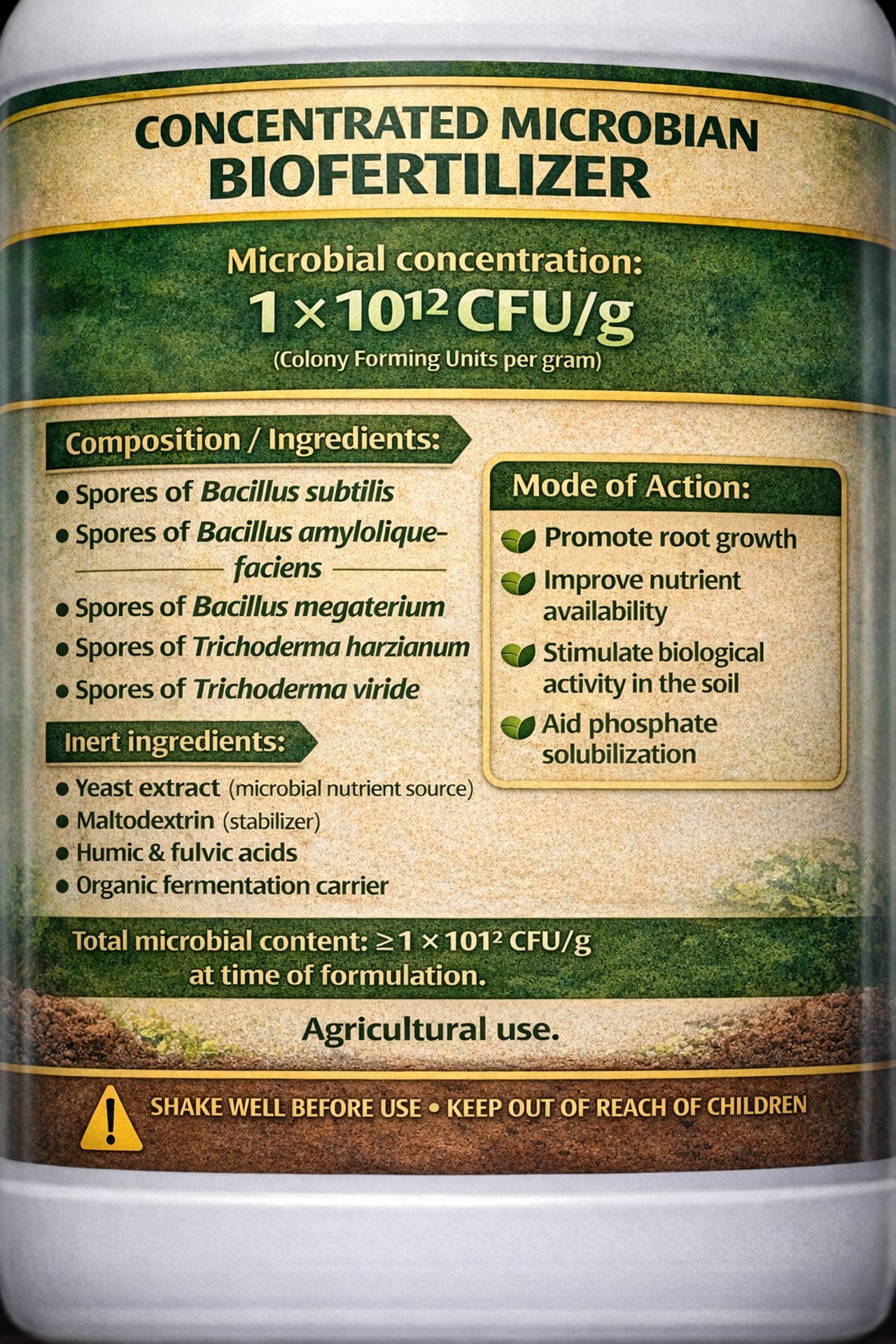
How to read a biological product label (what actually matters)
CFU, spores per gram, storage conditions, inert ingredients . Biological product labels carry critical information. Learn what to look for and what to question before you buy.
Last updated:
17 May 2026

Lina Avila Henao
Founder & Lead Consultant
When I started working with biological products, one of the first things I learned was that the label tells you almost everything you need to know — if you know what to look for.
The problem is that most people do not know how to interpret.
Farmers who have spent years working with chemical products are used to reading labels in a certain way. Active ingredient, dose, application method, safety precautions — straightforward. But biological product labels carry different information, use different units, and require a different kind of understanding.
If you are spending money on a biological product, you need to know what you are actually buying. The label is your first quality check. Let me walk you through what matters.
What is the active ingredient?
This is the first thing I look at, and it should be the first thing you look at too.
A biological product label should clearly state what microorganism or bioactive substance is in the product. This might be a single species — for example, Trichoderma harzianum or Bacillus subtilis — or it could be a consortium, meaning a combination of multiple microorganisms working together.
Both approaches have their place, but you need to know which one you are getting. A single-strain product is often more targeted, while a consortium aims to cover more ground. Neither is inherently better — it depends on what you are trying to achieve.
What matters is that the label names the organism clearly, ideally down to the species and strain level. If a label just says "beneficial microorganisms" without specifying what is inside, that is a red flag. You should know exactly what you are applying to your crop.
What is the concentration?
This is where many people get confused, and honestly, where many labels get misleading.
For microbial-based products, the concentration tells you how many living organisms are in the product. This is typically expressed in one of two ways:
Colony Forming Units per milliliter (CFU/mL) : for liquid products containing bacteria or fungi. This number represents the count of viable, living cells capable of multiplying. A typical high-quality product might claim 1×10⁹ CFU/mL or higher. Some products claim concentrations as high as 1×10¹² CFU/mL.
Spores per gram (spores/g) : more common for fungal products, particularly mycorrhizal inoculants and some entomopathogenic fungi formulations. This tells you how many fungal spores are present per gram of product.
Here is the important part: a higher number does not automatically mean a better product. What matters is that the concentration stated on the label is what is actually in the container when it reaches you. And that depends entirely on the manufacturer's quality control , something we will discuss in a future article.
When you see these numbers, ask yourself: is the manufacturer guaranteeing this concentration at the time of manufacture, or at the time of expiry? There is a big difference, because microbial populations decline over time. A well-made product with proper formulation and storage conditions will maintain its viability much longer than a poorly formulated one.
What is the expiry date and storage conditions?
This brings us to one of the most overlooked sections on any biological product label: storage instructions.
Biological products contain living organisms. Living organisms are sensitive to temperature, moisture, and light. If a product has been stored incorrectly, for example: left in the sun, exposed to extreme heat, kept for too long, the microorganisms inside may no longer be viable, regardless of what the label says.
The label should clearly state:
The recommended storage temperature. Many biological products need to be stored between 4 and 25°C, though this varies by product.
The shelf life refers to how long the product remains effective under proper storage conditions.
- Microbial-based products (bacteria, fungi): Typically 6 months to 2 years, depending on the formulation and storage conditions. Liquid formulations tend to have shorter shelf lives (6-12 months) because maintaining cell viability in liquid is harder. Powder and granular formulations (like wettable powders with dried spores) can last longer (up to 2 years if stored properly).
- Mycorrhizal products: These use spores, which are naturally more resilient. Shelf life is typically 12-24 months under proper conditions.
Whether refrigeration is required, some products must be refrigerated from the moment they are manufactured until they are applied.
If the label does not mention storage conditions, be cautious. And if you bought a product that has been sitting on a shelf in a hot warehouse for months, be aware that the concentration on the label may no longer reflect reality.
What are the application instructions?
A good biological product label will tell you:
How to apply it. Is it a seed treatment, a soil drench, a foliar spray, or applied through irrigation? Each method has specific requirements, and using the wrong one can reduce effectiveness dramatically.
When to apply it. Timing matters more with biologicals than with most chemical products. Some need to be applied preventively that means before the problem appears. Others need specific environmental conditions to work. The label should give you guidance on timing relative to the crop stage.
What to mix it with/ and what not to mix it with. This is critical. Some biological products are compatible with certain fertilizers or pesticides, and some are absolutely not. Mixing a Trichoderma-based product with a chemical fungicide, for example, could kill the microorganism you are trying to apply. The label should provide compatibility information, and if it does not, contact the manufacturer before tank-mixing.
How to dilute it. The recommended dilution rate affects the final concentration of microorganisms reaching your crop. Follow the label precisely, more is not always better with biological products.
What are the inert ingredients?
The label should also list the inert ingredients, the components of the product that are not the active microorganism or bioactive substance. These might include carriers (such as talc, peat, or liquid solutions), stabilizers, preservatives, and adjuvants.
Inert ingredients matter because they affect the product's shelf life, its compatibility with other inputs, and how it behaves during application. A well-formulated product uses inert ingredients that protect and support the active organisms, keeping them viable for longer.
If a label lists no inert ingredients at all, or if the inert ingredient list is vague, that is another thing worth questioning.
What the label does not tell you
There are things that you might not find on a label:
Full description of the strain. Many labels name the species (e.g., Bacillus subtilis) but not the specific strain. Different strains of the same species can have very different performance profiles. If a manufacturer provides strain-level information, it is usually a sign of a more serious, research-backed product.
There are things that you might not find on a label:
Full description of the strain. Many labels name the species (e.g., Bacillus subtilis) but not the specific strain. This is often intentional because the strain is usually the core of a company's intellectual property, and disclosing it could give competitors access to what makes their product unique. The regulatory body typically knows the strain (it is required for product registration), but the public-facing label may only show the species name. That said, different strains of the same species can have very different performance profiles, so this information matters. If a manufacturer provides strain-level information on the label, it is usually a sign of a more transparent, research-backed product — and often means they have strong patent protection or proprietary access to that strain.
Independent trial data. Labels are marketing tools as much as informational ones. Just because a label says "improves yield" or "enhances root growth" does not mean there is strong field trial data behind that claim. If a product interests you, look deeper into the manufacturer's research, visit their website, ask for published trial data, or request technical reports. A company that has invested in proper field trials will usually be willing to share the results. If they cannot, that tells you something too.
What happens in your specific conditions. No label can tell you exactly how a product will perform in your field, with your soil, your climate, and your management practices. The label gives you the baseline, the rest is about understanding biology and managing expectations.
A practical approach
Here is what I recommend when you pick up any biological product for the first time:
Read the active ingredient first. Know what organism or substance you are buying.
Check the concentration and understand the units — CFU/mL, spores/gram, or other measures.
Look at the expiry date and storage conditions. Ask the retailer how the product was stored.
Read the application instructions carefully. Pay special attention to compatibility warnings.
Check the inert ingredients. They should be listed and make sense for the type of product.
If any of this information is missing or unclear, think twice before purchasing. A serious manufacturer will provide all of this on the label because they have invested in getting the product right.
Final thought
The label is your first connection with a biological product. It tells you what is inside, how it was made, and how to use it. But only if you know how to read it.
In an industry where not every product delivers what it promises, the label is your first line of defense. Learn to read it well, and you will make better decisions for your crops, your investment, and your soil.
Lina Avila Henao
Founder & Lead Consultant