Transitioning from a Chemical to a Biologicals Lab: a practical guide
Setting up a biologicals lab from scratch takes planning, patience, and the right equipment. A practical guide based on my experience building a bio lab inside a chemical company.
Last updated:
17 May 2026
Lina Avila Henao
Founder & Lead Consultant
The room was empty. It had been allocated for something else entirely. But that was the space I was given, and from there, I had to build a biologicals production lab from scratch.
No equipment. No protocols. No team yet. Just a room and a mandate to make it work.
I was hired by a chemical company to set up their biologicals lab (a microbiology lab inside a company that had spent decades working exclusively with synthetic molecules). That experience taught me more about the practical realities of biological production than any textbook ever could.
If you are thinking about setting up your own lab (whether on a farm, as a small business, or inside an existing company) this article is what I wish someone had told me before I started.
Before you buy anything: define what you want to produce
This sounds obvious, but it is the step most people rush through.
The exact type of biostimulant or biological product you want to produce will determine everything that comes after, for example: the equipment, the processes, the chemicals, the expertise, and the budget.
Are you producing microbial-based products? Bacteria, fungi, or both? Are you working with plant extracts, seaweed-based formulations, or humic and fulvic acids? Each of these is a completely different production process with different requirements.
Do not try to do everything at once. Pick one product type and build around it. You can expand later once you have the foundation established.
Decide who this is for
This is an important decision that will affect your investment level.
If you plan to commercialize your products, the regulatory and quality standards will be stricter. You will need proper documentation, validated processes, and potentially product registration with the regulatory bodies in your country. This means a higher investment upfront.
If you are producing for your own farm, the standards can relax a little (but not as much as you might think). You still need quality control. You do not want to end up applying something harmful to your crop because you skipped a contamination check.
Be honest with yourself about where this is going. It will save you time and money.
Understand that this is about time
This is something I cannot stress enough.
Producing a biological product is a process that can take months or even years. It involves research and development, testing, optimizing, failing, adjusting, and testing again.
If you are in a hurry to create a product, slow down. Microorganisms and bioactive molecules require time and patience. They do not work on our schedule (they work on theirs).
From my experience, getting a small lab operational can take anywhere from three months to a year. It depends largely on how fast the suppliers of equipment move in your country. If your lab is in a remote location, add more time. The logistics of getting equipment delivered, installed, and calibrated is one of those things nobody warns you about.
Designing the space
Once you know what you want to produce, think carefully about the physical space.
The area needs to be specifically allocated for laboratory work. It should be enclosed, with sub-areas designated for different activities. Even in a small lab, you need to think about workflow, how materials move from one stage to the next without cross-contamination.
If you are building from scratch and have the resources, design a layout with these areas in mind:
A sterilization area: where you autoclave media, glassware, and tools.
A clean work area: where your laminar flow cabinet sits and where you do all aseptic handling of cultures. This is for me the most important.
A contaminated materials area: for waste and used materials waiting to be sterilized or disposed of.
An analysis area: for microscopy, readings, quality control checks, and sample processing.
The lab should also have good ventilation, proper lighting, connections to water and gas, temperature and humidity control for sensitive experiments. These details seem minor until you realize how much they affect the quality of your work and the viability of your cultures.
Essential equipment: start with the fundamentals
This is where the real investment begins, and it is also where I learned some of my hardest lessons.
When I was setting up the lab, my biggest headache was dealing with suppliers and timings. Researching good equipment that also fits your budget and space takes longer than you expect. And then waiting for delivery, dealing with customs if you are importing, coordinating installation (it all adds up).
My advice: start with the fundamentals. You do not need everything on day one.
The equipment you cannot work without:
The laminar flow cabinet is the most important piece for aseptic work. Without it, you cannot safely manipulate cultures, and contamination will be your constant enemy. This was the first thing I prioritized.
An autoclave for sterilization of media and glassware. Everything that touches your cultures needs to be sterile, and the autoclave is how you get there.
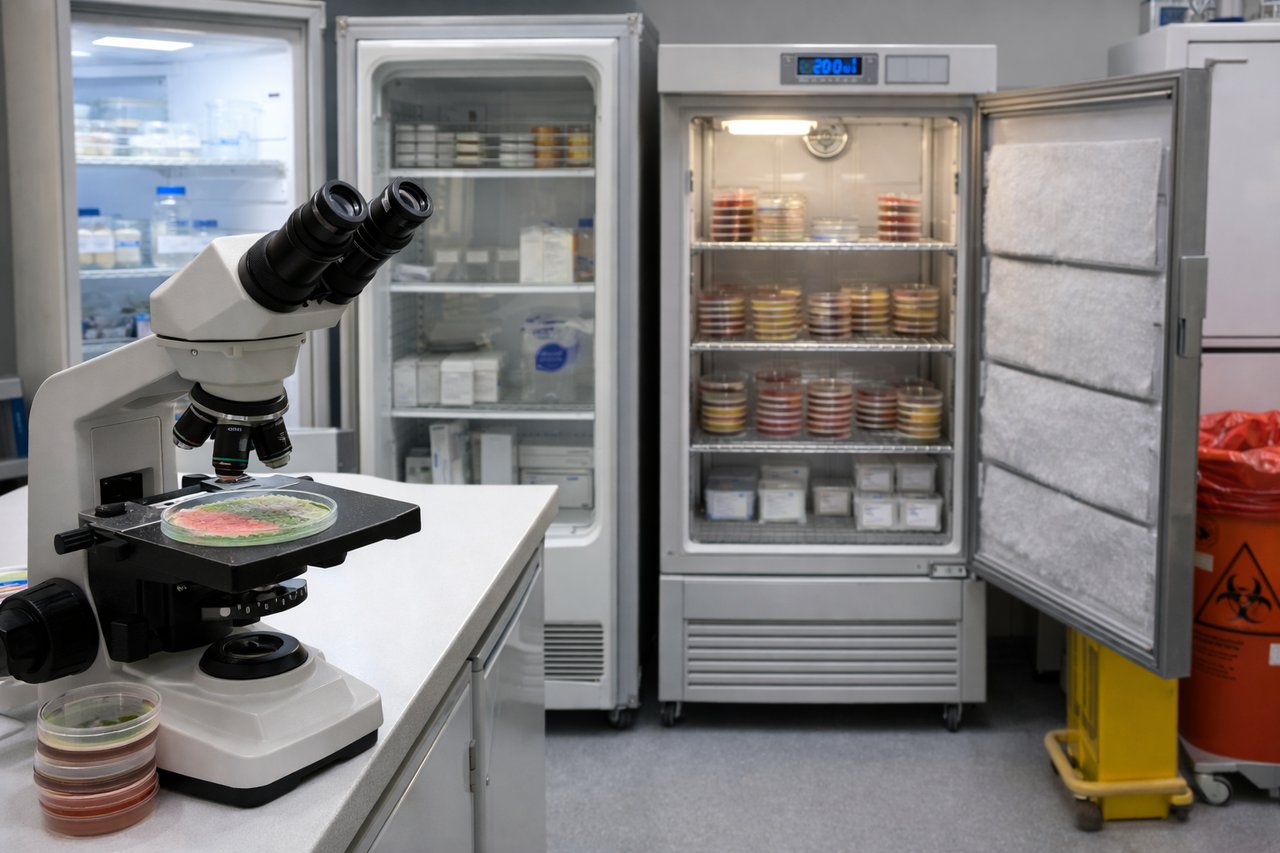
An incubator to maintain exact temperatures for microorganism growth. Bacteria and fungi have specific temperature requirements, and you need to control this precisely.
A refrigerator for storing prepared media, reagents, and samples. A freezer for preserving mother cultures safely (this is your treasure, your production depends on the strains).
A microscope for identification work and quality control. You need to see or confirm what you are growing.
An analytical scale for weighing culture media components accurately.
Hot plates and magnetic stirrers for media preparation and homogenization.
A pH meter for adjusting the pH of your media. Microbial growth is highly pH-sensitive.
Glassware flasks, test tubes, blue-capped jars for culturing and media preparation.
When you are ready to scale up:
Fermentation equipment: bioreactors with controlled conditions for pH, temperature, dissolved oxygen, stirring, and aeration. This is a big investment when you move from small-scale to production-scale.
A spectrophotometer: to measure microbial cell concentration by optical density. This is how you monitor growth objectively.
Extraction equipment: if you are producing plant or seaweed-based biostimulants.
Formulation equipment: mixers, sifters, stirrers for preparing the final product.
Packaging equipment for bottling or packaging in appropriate containers.
For some specialized analyses, you can connect with an external laboratory rather than purchasing expensive analytical equipment upfront. This is a practical way to manage costs early on.
Active ingredients and reagents
Every process needs a starting point. For biological products, that starting point is the active ingredient plus the components that support it.
Microbial cultures: If you are producing microbial-based products, you need starter cultures of beneficial microorganisms. You can isolate these yourself from field samples or obtain them from a reputable culture collection or research lab. Either way, start with a clean, verified strain.
Nutrient sources: Your microorganisms need food to grow. This means culture media such as agars for solid growth, broths for liquid production. Bacteria and fungi need carbon and nitrogen sources, plus salts and minerals.
Reagents and stabilizers: These are used to prepare the right conditions for microbial growth, adjusting pH, dissolving nutrients, or triggering specific biological processes.
Preservatives and adjuvants: Preservatives prevent microbial contamination during storage. Adjuvants improve the product's performance in the field, its absorption, adherence to plant surfaces, or compatibility with other agricultural inputs. Together, they extend shelf life and ensure the final product remains viable and effective.
The people behind the lab
A skilled team is essential, though the size depends on your production capacity.
At minimum, you need someone with microbiology expertise for research and development. As you grow, you will need laboratory technicians for day-to-day processes, quality control specialists to analyze and validate products, and eventually a production manager to oversee operations.
Do not underestimate the human element. The best equipment in the world is only as good as the people operating it.
The core production process
Let me walk you through the basic steps, briefly. If you want more detail on the methodology of reproducing microorganisms, that worths a consultation with me!
Mother culture. Start with a clean, verified strain. This is your foundation, everything depends on the quality of your starting material.
Media preparation. Prepare a culture medium suited to your specific microorganism. Getting this right is about adjusting conditions and ingredients.
Inoculation and multiplication. Introduce your organism into the prepared medium and allow it to multiply under controlled conditions.
Incubation. Let it incubate, typically 2 to 3 days, though this varies depending on the microorganism.
Growth monitoring. Track the number of viable cells throughout the process. This growth curve tells you when the culture is in its exponential phase (that is when you want to harvest, because that is when cell counts are highest and the organisms are most active).
Quality control. Count the cells present at the end of your process, check they are viable and run a contamination check. You need to confirm that what you grew is what you intended to grow, and that nothing else got in.
Scaling up
If your tests are successful at small scale and your experimental product is performing well, you are ready to scale up. This stage requires bigger bioreactors, more raw materials, increased packaging capacity, and more rigorous process documentation.
Scaling up is not simply doing more of the same — it introduces new challenges. Maintaining consistency at larger volumes, managing heat dissipation in bigger fermenters, and ensuring homogeneous mixing all become critical. This is where many promising products fail, and it is where having experienced people on your team makes the biggest difference.
Regulatory compliance
Do not leave this until the end. Understanding regulatory requirements should be part of your planning from day one.
Good Manufacturing Practices (GMP): Your lab must be adequate and meet the standards required to produce biostimulants consistently and safely.
Waste management: You need an external entity that regularly collects laboratory waste and disposes of it according to local regulations. This is not optional.
Market approval: If you plan to sell your products, you will likely need registration with the regulatory bodies in your country. This process varies widely, in some countries it takes months, in others it can take years so start early.
Testing before you sell
Before commercializing any product, you need field trial data. Laboratory results are a starting point, but the real test happens in the crop, in the field, under real conditions.
Trials help you assess shelf life under real storage conditions, effectiveness against the target problem, optimal application rates and timing, and actual benefits for the plants and yield.
Do not skip this step. It is what separates a laboratory experiment from a commercial product.
Final thought
Setting up a biologicals production lab is not a simple process. But it is an investment in one of the most promising sectors in agriculture today.
The industry is shifting. Farmers are looking for alternatives. Companies are diversifying their portfolios. And there is a genuine need for well-made, reliable biological products.
I built a lab from an empty room. It took time, it took patience, and it took a lot of problem-solving. But it is one of the most rewarding things I have done in my career.
If you are thinking about taking this step, know that it is possible. It just requires the right preparation, the right expectations, and a willingness to experiment.
Lina Avila Henao
Founder & Lead Consultant